Nebraska’s Wide, Rolling Domain
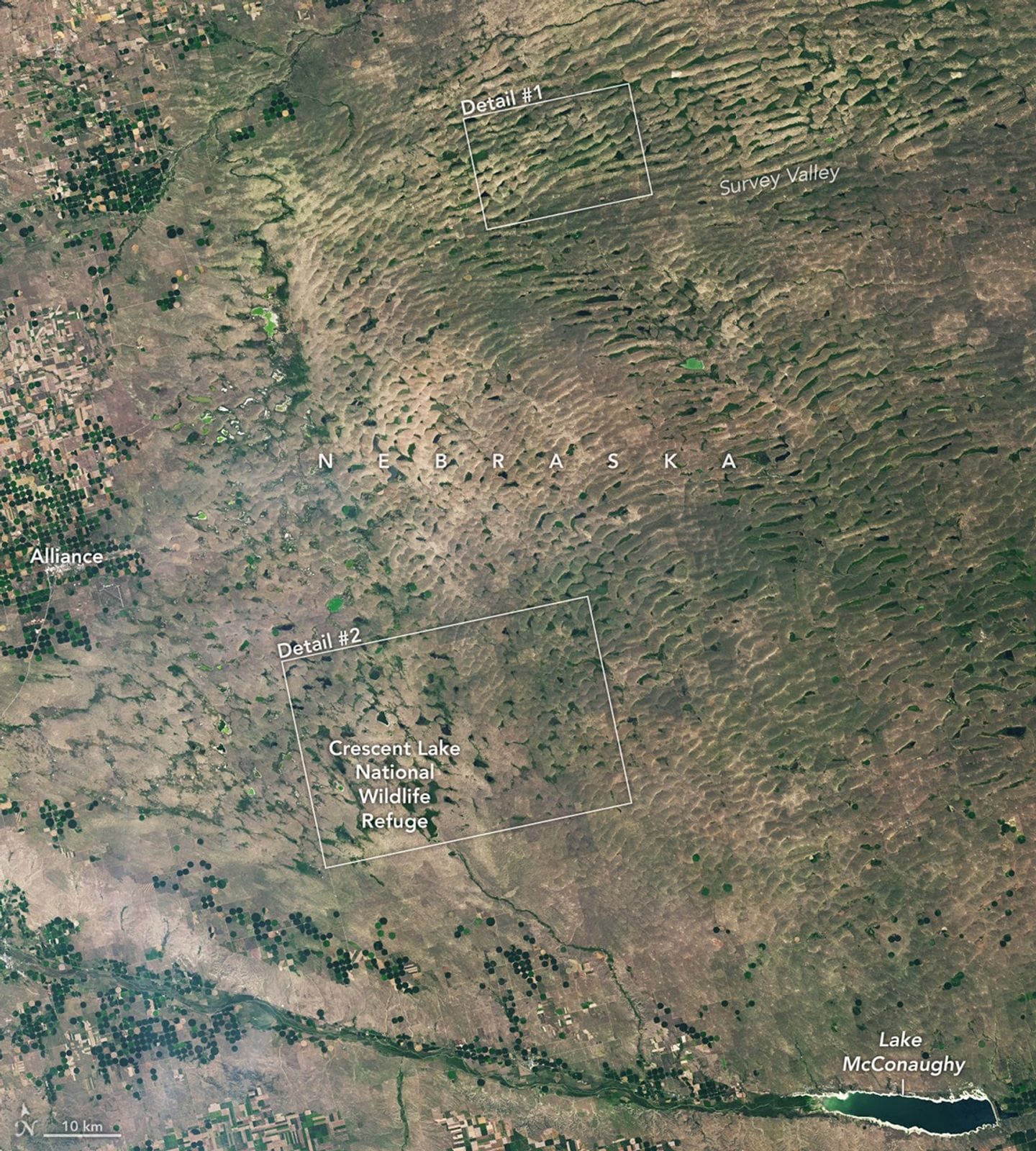
The Nebraska Sandhills—the largest system of sand dunes in the Western Hemisphere—cover roughly one-quarter of the state. Grasslands blanket the rolling hills and provide pasture, while lakes and wetlands in the valleys support a wide variety of plants and animals.
Much of the sand came from the Rocky Mountains. Rivers carried eroded material across the Great Plains during the Pleistocene, and winds later lofted sand from dried riverbeds, building and shaping dunes until grassland vegetation stabilized them about 3,500 years ago.
The rippled pattern now spans about 20,000 square miles (52,000 square kilometers). Some of the largest dunes, particularly near the northern edge of the region, are transverse forms that reach heights of 400 feet (120 meters) and run for several miles. Their northern slopes are gentler than their southern slopes, reflecting dominant northerly winds; in other places, more symmetric dunes suggest winds shifted seasonally between north and south.
nebraska sandhills, sand dunes, great plains, pleistocene, rocky mountains, grasslands, wetlands, transverse dunes, dune heights, wind patterns