Apollo astronauts rehearsed lunar geology in Alaska's ash-filled valley
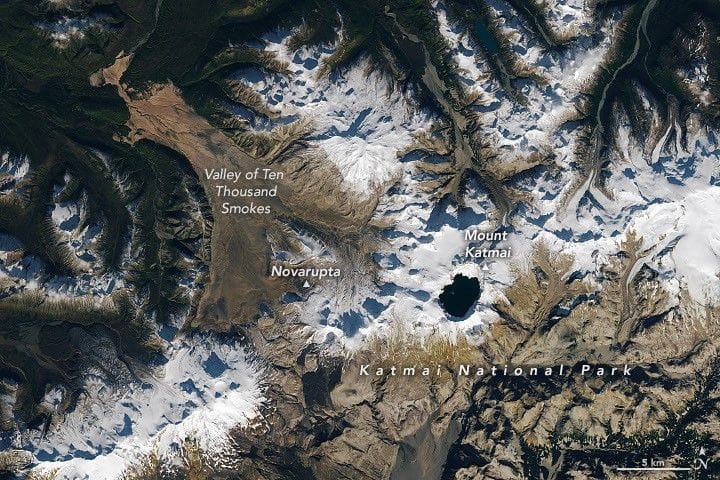
Preparing to visit the Moon, Apollo astronauts practiced field geology in Alaska’s remote Katmai National Park. In the summers of 1965 and 1966 they carried out simulations in the Valley of Ten Thousand Smokes, a volcanic landscape used to mimic unfamiliar extraterrestrial terrain.
William Phinney, Apollo’s science training coordinator, described an exercise called the “Moon game.” Pairs of astronauts were placed at unfamiliar field sites, tasked with collecting representative geologic samples and practicing how to communicate their observations to scientists.
The valley preserves the massive ash flow deposited by Novarupta’s 1912 eruption—the largest volcanic event on Earth in the 20th century. The deposit measures up to 660 feet (200 meters) thick and was emplaced at about 1,380 degrees Fahrenheit (750 degrees Celsius).
United States, Katmai National Park, Alaska
apollo astronauts, lunar geology, katmai, alaska, novarupta, 1912 eruption, ash flow, moon game, william phinney, volcanic deposit