Jabal al Fāyah's Ridges Reveal Ancient Seas and Early Human Sites
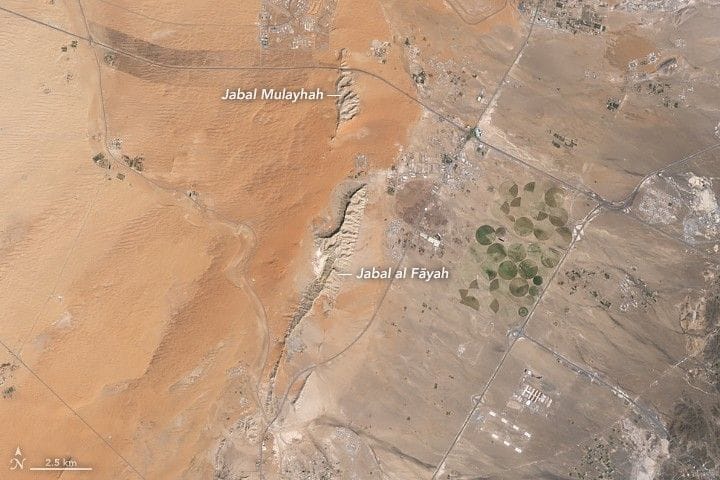
About an hour’s drive east of Dubai, at the northern edge of the Rub’ al Khali, pale limestone ridges rise from the desert plain, the largest—Jabal al Fāyah—reaching 412 meters above sea level. Landsat 8 captured this landscape on October 23, 2025, where saffron-colored sand meets the Al-Hajar Mountains and dune fields collected west of the ridge show an orange hue from weathered iron-bearing minerals.
Geologists see the ridges as remnants of a time when the region lay under a shallow sea; marine limestone was deposited over tens of millions of years from the late Cretaceous through the early to mid-Paleocene. To the east, overlapping alluvial fans carry gravels and eroded sediments from basalts and other dark mafic rocks, and the adjacent Samail Ophiolite stands out as one of the largest, best-preserved exposures of ancient oceanic lithosphere—rock that was thrust onto the Arabian plate through obduction.
United Arab Emirates, Dubai
al fayah, empty quarter, landsat 8, al hajar, pale limestone, marine limestone, samail ophiolite, obduction, late cretaceous, paleocene