12 rules for agentic AI to succeed in the enterprise
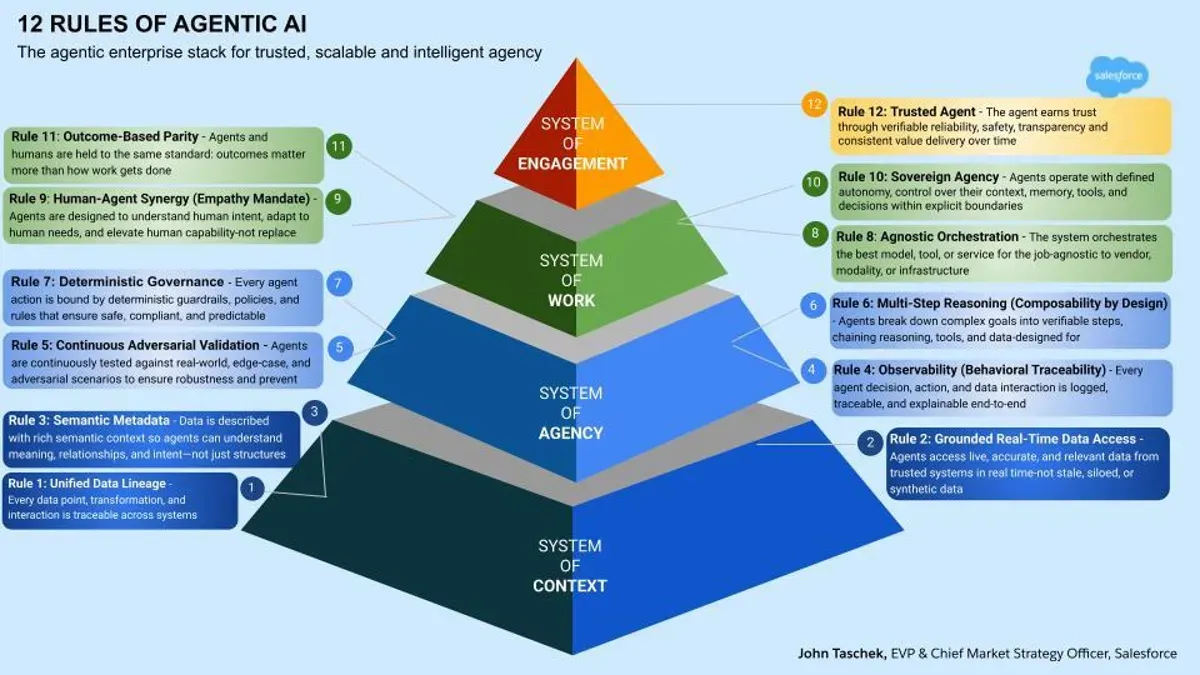
Many agentic AI deployment failures are architectural rather than AI problems, rooted in poor data, weak governance and missing operational practices. Salesforce and industry research find pilots often emphasize capability and speed while skipping the work of earning business trust; common mistakes include overreliance on language models, encoding policies instead of robust prompting logic, and poor context engineering.
Salesforce also notes that with traditional software most work is done before launch, whereas with AI agents the bulk of effort occurs after production — managing, testing and improving them. John Taschek, Salesforce's EVP and chief market strategy officer, distilled lessons from thousands of deployments into 12 vendor-neutral rules for agentic AI.
The framework is evidence-based and architecture-led, inspired by Codd’s 12 rules for relational databases. Its foundation rules require unified data lineage, grounded real-time data access, and semantic metadata so agents understand meaning, not just raw values.
agentic ai, enterprise ai, salesforce, data lineage, real-time data, semantic metadata, data governance, prompting logic, context engineering, operational practices