NASA’s Dragonfly Flight System Faces Heat
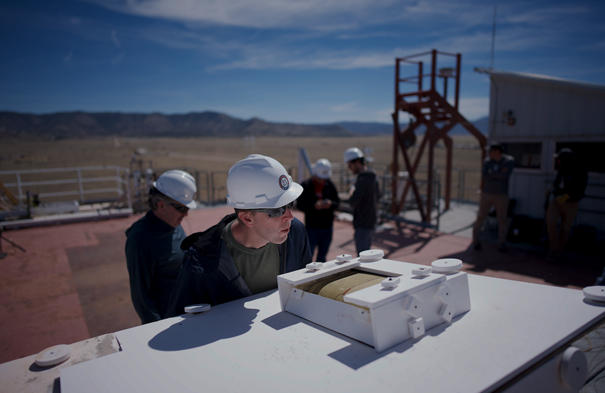
The heat shield for NASA’s Dragonfly completed thermal-structural testing in the New Mexico desert. Team members from NASA’s Ames Research Center, the Johns Hopkins Applied Physics Laboratory and Lockheed Martin collaborated with personnel at Sandia National Laboratories’ National Solar Thermal Test Facility to stress-test the shield materials, ensuring the rotorcraft will be safely delivered through Titan’s dense atmosphere.
Dragonfly’s thermal protection material, made from carbon fiber and a lightweight resin, performed as expected in combined mechanical and thermal testing, even when intentionally marred with defects. Operators generated temperatures around 4,500 degrees Fahrenheit (nearly 2,500 degrees Celsius) on segments of the heat-shield material using Sandia’s Solar Tower, and tests examined tolerance to thermal radiation as well as the rapid change in temperature researchers expect during entry.
United States, New Mexico
dragonfly, heat shield, thermal testing, sandia, solar tower, titan atmosphere, carbon fiber, nasa ames, johns hopkins, lockheed martin